
Our Heritage RNAD collection
After the First World War the Royal Navy recognised that, to be fully prepared for any future conflict, it needed additional munitions and general stores depots capable of supplying shells, mines, torpedoes and the wide range of ancillary items required by a modern fleet. During the 1930s several major new facilities were established, including large armaments depots at Trecwn in South Wales, Dean Hill in Wiltshire and Broughton Moor in Cumbria, the latter making use of a former coal mine. General stores depots were also created, such as the extensive underground complex at Copenacre in Wiltshire, which occupied 125 acres of tunnels in a former Bath Stone quarry.
Munitions were typically stored in underground galleries, and a network of 2‑foot 6‑inch gauge railways was laid throughout each site to move materials between magazines, workshops and the adjacent main line railways. The main line brought munitions in from factories and carried finished stores out to naval dockyards for loading onto ships. To support this work a standardised range of narrow‑gauge wagons was developed, all built on a universal chassis but fitted with different bodies depending on their role. They were constructed with wooden bodies and load beds, and used phosphor‑bronze fixings to minimise the risk of sparks and accidental detonation. These wagons remained in service with very little alteration until the closure of the depots at the end of the Cold War.
When the Royal Naval Depots closed, many of the locomotives and wagons from the 2‑foot 6‑inch systems were scrapped without ceremony, and only a small number survived. Over time, surviving wagons were often rebuilt or modified to suit new owners, including re‑gauging down to 2ft or up to 3ft and altering bodywork. As a result, original‑gauge, largely unmodified RNAD wagons have become increasingly rare.
RNAD wagons matter because they are one of the last tangible links to a vast, largely invisible military logistics and industrial railway system that supported the UK’s defence infrastructure for nearly a century. Most disappeared when the depots shut, and only a tiny fraction remain in any form with fewer still in their original 2‑foot 6‑inch gauge, unconverted and unmodified.
The Gunpowder Railway has around fifteen surviving examples together (not all restored or included on this list), still to their correct gauge and liveries and covering almost all of the main wagon types. Visitors can see construction variations, different depot practices, numbering systems and the evolution of RNAD wagons over time, making the collection a useful reference for this once‑widespread but now largely lost railway system.
RNAD Closed Ordnance Vans
These vans are perhaps the most distinctive of all the narrow gauge wagons in use at the various Royal Naval Armaments Depots. Built on the standard wagon chassis, the body is constructed of tongue and groove timber planks using seasoned teak. The bodies have not only the usual opening side doors
but also a pair of roof doors that can be slid back towards the two ends, giving a completely clear area in the centre of the vehicle for loading and unloading larger items of naval ordnance. They were particularly designed for the transport of sea mines, which were lowered into the vehicle through the roof, the usual load being two, placed one in each end of the interior.
Unlike the open ammunition wagons, these vans incorporated double panelling, typically an inner layer of teak and an outer layer of oak. The differing densities and grain structures reduced the chance of friction‑spark transfer and provided a sacrificial buffer should an internal container rupture.
Together, these features made the gunpowder van one of the most technically refined vehicles in the RNAD fleet, engineered to minimise ignition risks while enabling the handling of some of the most dangerous stores in naval service.
Unfortunately it proved to be almost impossible to make the roof doors properly watertight and many of these vans suffered from extensive rotting to the timber floors and even the steel chassis members during their fifty years of commercial service.
On preserved and heritage railways most surviving vans have had their roof doors removed and many have been entirely re-bodied, leaving surviving original examples the exception rather than the rule!

TO211 (GR-T3) Now a Semi-Open Passenger Carriage
Built: Cravens Wagon & Coach Works, Leeds in 1940’s
Original Location: RNAD Trecwn, Wales
Originally a Closed Van converted to a Passenger Carriage.
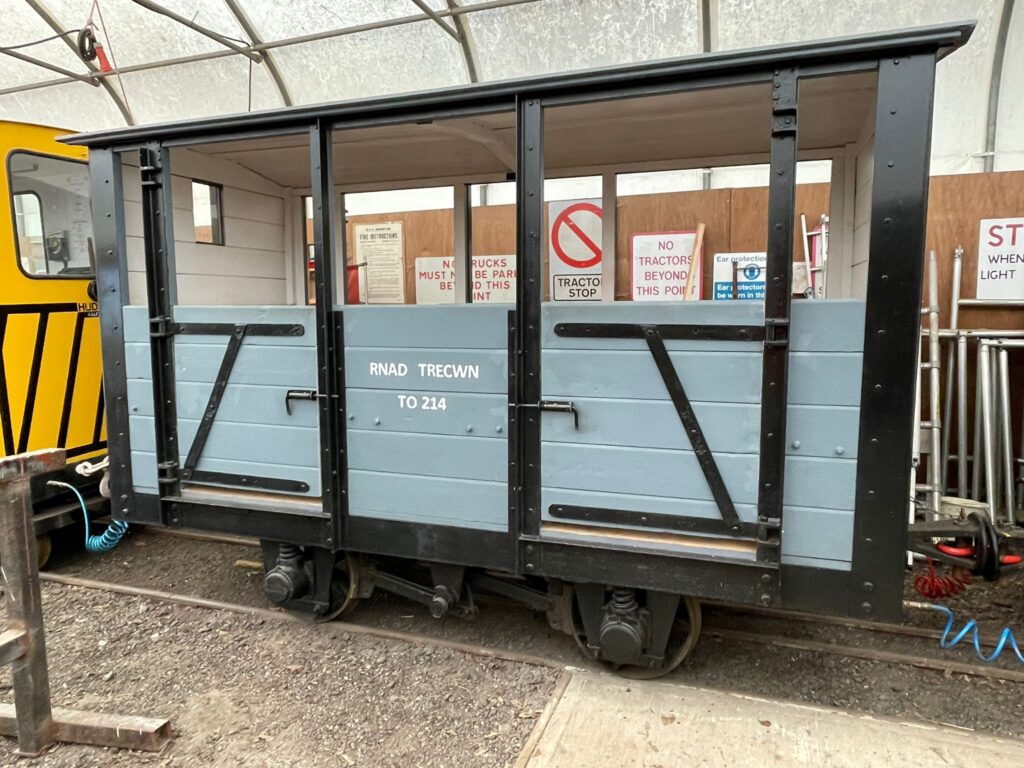
TO214 (GR-T4) Now a Semi-Open Passenger Carriage
Built: Cravens Wagon & Coach Works, Leeds in 1940’s
Original Location: RNAD Trecwn, Wales
Originally a Closed Van converted to a Passenger Carriage.

TO-183 (GR-T1) Closed Van
Built: Cravens, Sheffield in 1941
Original Location: RNAD Trecwn, Wales
The grey colour this example is painted in was applied to closed vans after 1948 when grey paint pigments became more widely available.

TO-184 (GR-T2) Closed Van
Built: Charles Roberts & Co Ltd, Wakefield in 1940
Original Location: RNAD Trecwn, Wales
Note, the number TO-184 is probably incorrect but the details of the original number have been lost.
This example is in the war time reddish-brown paint colour, similar to Bauxite. This was because during World War 2, the chemical pigments for grey and green paint colours were diverted for us in front-line vehicles (such as airplanes) leaving browns available for UK based rolling stock.
Personnel Carriers
RNAD sites were vast, dispersed industrial landscapes, and moving staff efficiently around them was essential to daily operations. In the 1940s this was often done with simple manriders basic seated wagons coupled behind locomotives to shuttle workers between magazines, workshops and inspection points. Additional out of use closed “gunpowder” vans were converted into brake vans and personell carriers. By the 1980s this approach had evolved into purpose‑built steel‑bodied bogie crew vans, many supplied by Hudson Raletrux for military establishments including munitions depots. These later vehicles offered enclosed transport, better protection from weather and noise, and safer movement across long internal rail networks. They were typically finished in green or blue, while examples painted yellow came from sites operating under NATO protocols, where yellow denoted plant and equipment.

TO-155 (GR-T7) 4w Bogie Crew and Brake van
Built: R Hudson & Co, Leeds in 1982
Original Location: RNAD Trecwn, Wales
Armaments / Munitions Transport
Flat Wagons
RNAD flat wagons were the workhorses of the depots, built with open decks and fitted with distinctive end rails that varied between sites and build periods. All had a number of horizontal bars designed to give strong anchor points for ropes, chains or webbing. These rails allowed crews to secure everything from ammunition crates to machinery, mine casings and heavy stores, adapting the same basic wagon to an enormous range of loads.

TO-292 (GR-T6) 4w 4-plank Flat Wagon
Built: R & Y Pickering Ltd, Wishaw date unknown.
Original Location: RNAD Trecwn, Wales
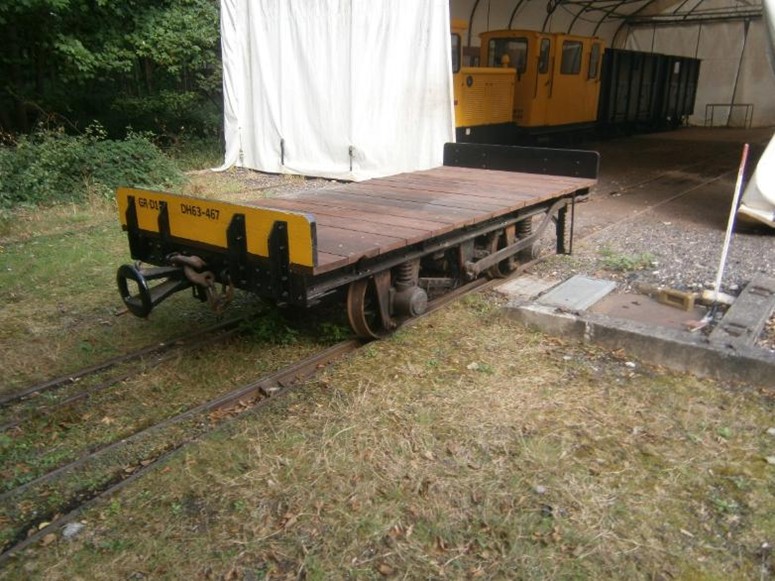
DH63-467 (GR-D1) 4w 1 Plank Flat Wagon
Built: Manufacturer and date is unknown.
Original Location: RNAD Dean Hill, Wiltshire

Awaiting Restoration – RNAD Brake Van
RNAD brake vans were compact, fully enclosed vehicles divided into simple internal compartments which featured side entrances into bench‑seated sections where guards and depot staff could ride, with brake equipment and basic tools housed within the same body. Built on the standard RNAD wheelbase. These vans were designed for heavy internal trains, providing both braking control while munitions and stores were moved around the depot.
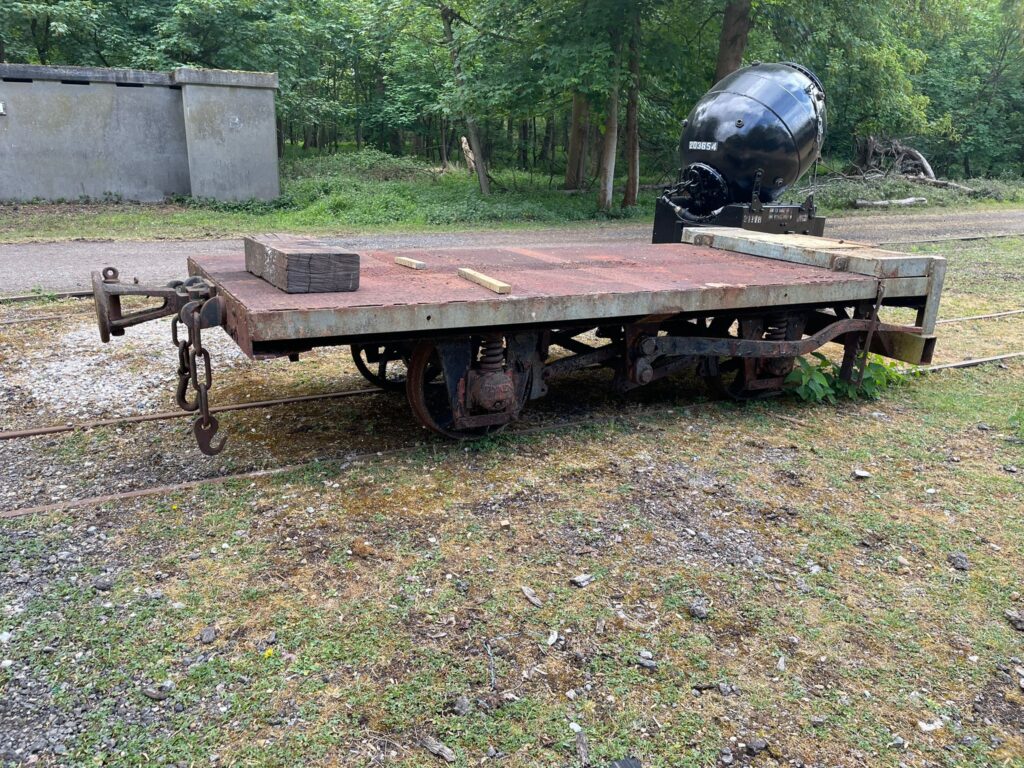
BM-233 (GR-BM1) 4w Brake Van
Built: Charles Roberts & Co Ltd, Wakefield in 1944
Original Location: RNAD Broughton Moor
It takes a bit of imagination to see what this one will look like once restored as its missing all of its body work….