
Locomotive Rolling Stock at the Gunpowder Railway
We have a wide ranged of preserved, operational locomotives the majority are from ex-Royal Navy Armament Depot (RNAD) or Royal-Ordinance Factory (ROF) railways. All are diesel powered and operate to our 2foot 6inch (762mm) gauge track.
We have 5 operational locomotives, 1 new build in process and 1 under restoration (plus a visiting locomotive awaiting restoration); all others are static and there are no plans to restore.
You can also:
– read about our Rolling Stock the locomotives use.
– find out about the origins of our locomotives names.
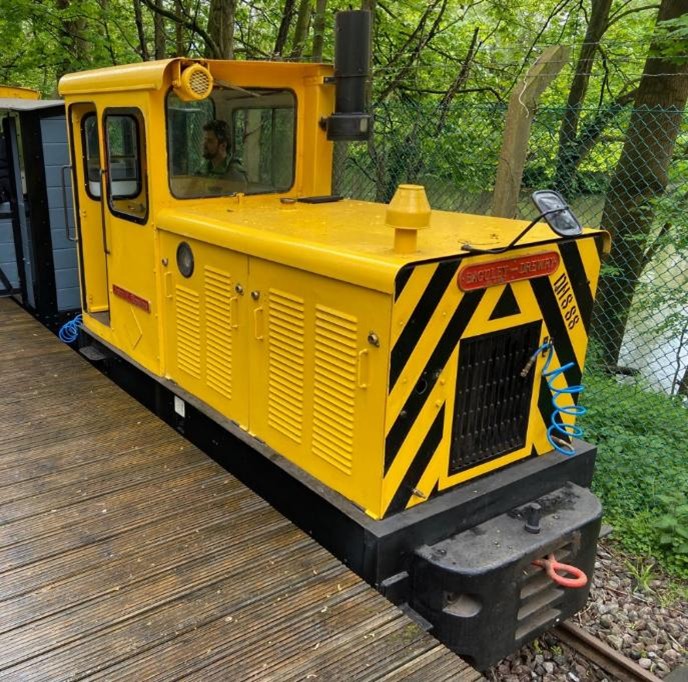
Baguley-Drewry 4wDH works no. 3755
Status: OPERATIONAL
Built: 1981 by Baguley-Drewry
Name: John H Bowles
Use Today: Passenger Trains
Original Location: RNAD Trecwn, Wales
This locomotive marks the later evolution of RNAD Depot narrow‑gauge diesel design when compared to Tinkabell. Delivered new in 1981 to Royal Naval Armament Depot Trecwn, Wales as A4 and subsequently renumbered to TO-004-00-NZ-29 in 1984.
Transferred to RNAD Dean Hill in 1994 along with several others when new 100hp Baguley locomotives introduced at Trecwn, and renumbered as DH8-88.
Dean Hill closed in 2004 and most of the railway stock was sold off with only DH8-87 and DH8-88 remaining in use at Dean Hill during its decommissioning. DH8-88 then transferred to the Gunpowder Railway in 2009.
This locomotive is available in 009 scale model form made by Bachmann.

Hunslet 4wDM works no. 8819
Status: OPERATIONAL
Built: 1979 by Hunslet
Name: Gilbert
Use Today: Passenger Trains (Backup locomotive)
Original Location: NCB Nantgarw Colliery, Wales
Delivered new to the National Coal Board and used at Nantgarw Colliery, South Wales. The locomotive was originally 3 feet (914mm) gauge as built. The colliery closed 1986 and sometime after the locomotive ended up at at Bressingham Gardens and Steam Museum, Norfolk where it was re-gauged to 2 feet..
The locomotive was subsequently fully overhauled at Statfold Barn Museum, including fitting of a new 65hp Kubota Diesel engine along with modified coupling heights and an air-braking system along with being regauged to 2 feet 6 inches (762mm).
The locomotive transferred to the Gunpowder Railway in December 2021.

Hunslet 4wDH works no. 8828
Status: OPERATIONAL
Built: 1979 by Hunslet
Name: Chris H / Number 4
Use Today: Works Trains
Original Location: ROF Bishopton, Scotland
Delivered new to Royal Ordnance Factory, Bishopton, Renfrewshire as Number 4. ROF Bishopton was a massive, top-secret Ministry of Supply explosives factory built during World War II to manufacture cordite propellant for the British military replacing the Gunpowder Mills in Waltham Abbey. Because cordite is highly volatile, safety was paramount. Buildings were spaced far apart across 890 acres of land to isolate accidental explosions and an 80-mile railway was built to move materials about.
In 1979 the factory brought in a number of custom-built Hunslet 4wDH locomotives to modernize the fleet an initial batch of 6 and 8828 was number 4 of the 6. A further batch of 6 number 7-12 was delivered in 1980. Operating at Bishopton until 1990 when it suffered a catastrophic engine fire taking it out of service. It was left out of use at Bishopton before being transferred to Shoeburyness MOD site in 1994 and subsequently receiving a new engine.
Arrived at the Gunpowder Railway in an un-restored, non-operational condition in 2003 and was the first locomotive on-site. Restored to operation by 2007.
Of the original Bishopton Hunslets – 10 of the 12 locomotives are known to survive although most are not operational.
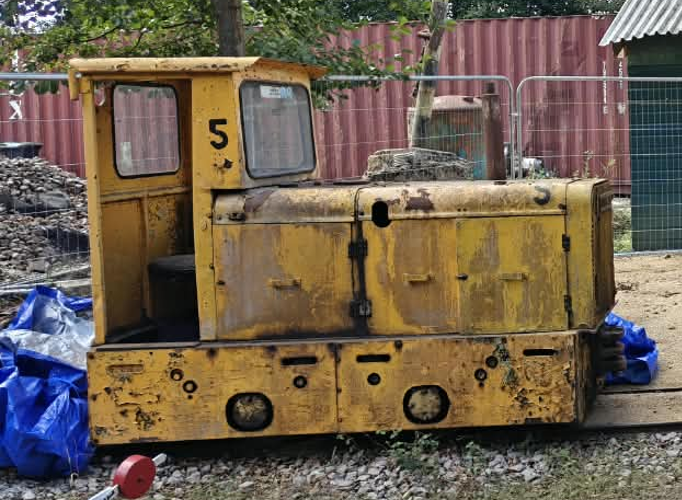
Hunslet 4wDH works no. 8829
Status: REQUIRING RESTORATION
Built: 1979 by Hunslet
Name: Betsy / Number 5
Use Today: Visiting Locomotive
Original Location: ROF Bishopton, Scotland
This is the sister locomotive to Chris H, and is number 5 from the original batch of 6 identical Hunslets delivered in 1979 to ROF Bishopton in Scotland.
It continued in use there until the site closed in 2002 and was then sold into a private collection. It has recently changed ownership but remains privately owned and is only visiting the Gunpowder Railway while it goes through a restoration back to operational condition.
Currently there is a rare chance to see this locomotive, in original ROF Bishopton livery, within the Railway Works until it moves back to a private location.
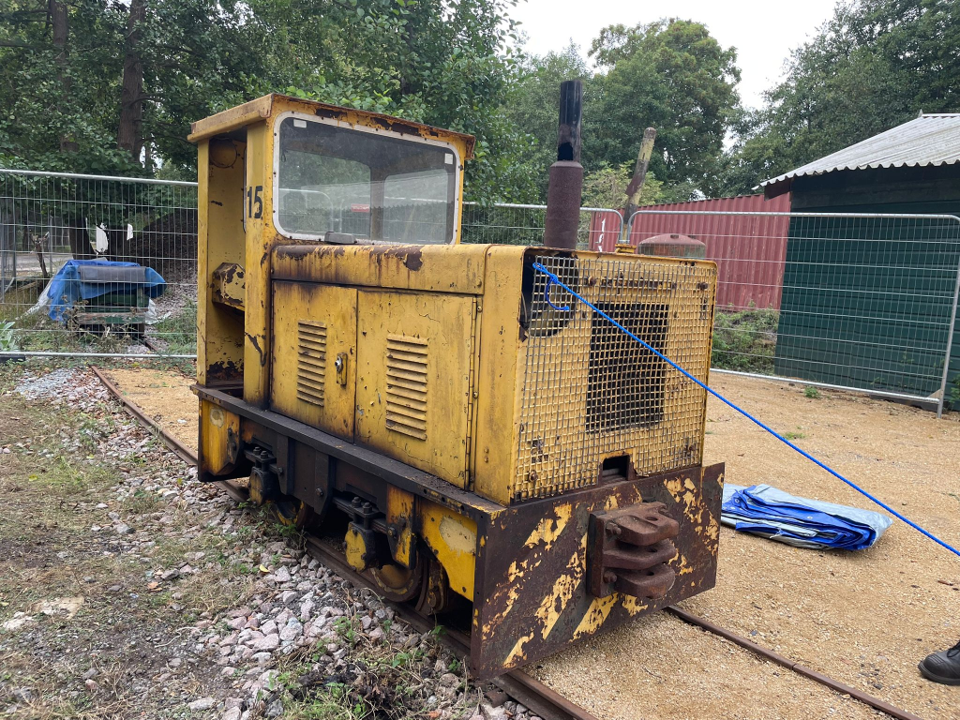
Hunslet 4wDH works no. 9080
Status: UNDER RESTORATION
Built: 1984 by Hunslet
Name: “15”
Proposed Use: Passenger Trains
Original Location: ROF Bishopton, Scotland
In 1984 production of Cordite as ROF Bishopton was at its peak and there was the need for additional, more powerful Hunslet locomotives to compliment those already on site. An order was placed for 4 more – 2 to CAT.C specification (this means fireproofed) numbers “13” and “14” and 2 simply more powerful bulkier locomotives – numbers “15” and “16”.
These locomotives operated until Bishopton closed in 2002 and were then sold – this one, along with number “16” went into a private collection and has been in a barn out of use for over 20 years.
It arrived at the Gunpowder Railway in September 2026 and will be restored to fully working order and its livery repainted with the aim for it to be in passenger service in 2027.
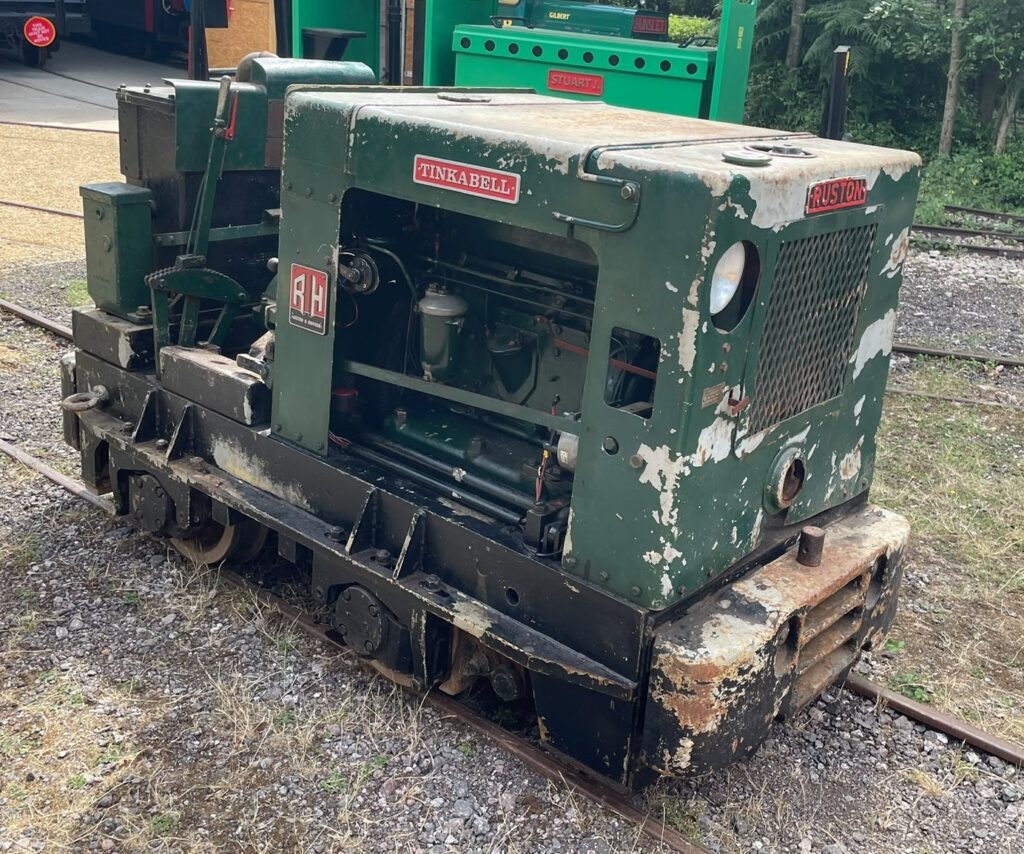
Ruston LBU 4wDM works no. 398101
Status: OPERATIONAL (having repaint)
Built: 1956 by Ruston & Hornsby
Name: Tinkabell
Use Today: Special Request Passenger Trains
Original Location: RNSD Copenacre
Built by Ruston and Hornsby of Lincoln, UK and ordered new by the MoD for RNSD Copenacre, part of the CAD Corsham underground complex to complement their existing Ruston 16/20 locomotives from the 1930’s. Worked entirely underground, moving munitions and naval stores through a 125 acre tunnel network.
This is the super rare 3-cylinder, 3-speed variant of the Ruston LBU less than a dozen were ever manufactured and this is believed to be the last one remaining. Unlike deep, cramped coal mines that strictly required slow, high-torque hauling, the tunnels at RNSD Copenacre were expansive, well-maintained, and concrete-lined. The MoD needed a locomotive that could safely haul ammunition at low speeds, but also shift into a third “cruising” gear to shuffle empty wagons quickly across the vast site.
Tinkabell became surplus to requirements in 1982 and then entered private hands. It initially worked at a stone and concrete quarry in Somerset before being placed into long-term storage.
Arrived at Waltham Abbey for use on the Gunpowder Railway in April 2026 and went through two months of mechanical restoration now receiving a cosmetic refurbishment.

Ruhrthaler 4wDM works no. 3920
Status: OPERATIONAL
Built: 1969 as a G100 H/VW
Name: Il Tuono Blu / The Blue Thunder
Use Today: Stock Moves
Original Location: Rome, Italy
Built by Ruhrthaler Maschinenfabrik of Mülheim, Germany and delivered new on 28th November 1969 to S.A. Costruzione per Opere Pubbliche, (SACOP) Rome as a standard two cab mining/tunneling locomotive for use on the construction of Rome Metro Line ‘A’ tunnels between 1969 and 1980.
Imported to UK in 1994 by contractor J. F. Donelon & Co of Horwich (later Amey Donelon) for use on a tunneling project in Bristol. Then at an unknown date the original coupling units were removed then replaced and one cab was also removed along with the roof of the other cab.
Arrived at Waltham Abbey for use on the Gunpowder Railway on 13th September 2007 in an unservicable and failed condition and so placed into long term storage for 17 years!
Between January and August 2024 the locomotive was completely overhauled, rebuilt and returned to operating condition and fully refurbished externally.

Wickham Trolley 4wDM
Status: NEW BUILD IN PROGRESS
Built: 2026
Proposed Use: Track Gang and Inspection
Original Location: RGM Waltham Abbey
Wickham trolleys were lightweight railway inspection and maintenance vehicles built in Ware, Hertfordshire by D. Wickham & Co., a long‑established engineering firm that introduced its first rail trolley in 1922 and continued production until 1990.
Although best known for standard‑gauge personnel carriers, the company also produced a number of narrow‑gauge variants, including rare examples built to 2‑ft and 2‑ft‑6‑in gauges for military and industrial use. One documented narrow‑gauge example was built in 1938 for military service, later preserved after its use at Lydd in Kent.
Given the closeness of Ware to the Waltham Abbey site of the Gunpowder Railway a new-build example of these rare narrow gauge military variants is currently under construction.

Greenwood and Batley 4wBE (Battery) works no. 1671
Status: STATIC DISPLAY
Built: 1941 (2024 replica – original does not survive)
Name: Stuart J
Original Location: RGM Waltham Abbey
In 1940 and 1941 the Waltham Abbey Royal Gunpowder Mills placed orders with the pre-eminent Battery Electric Locomotive manufacturer in Britain, Greenwood and Batley of Leeds, for 14 new machines to cope with the increased production on the site. Power was provided by a 5hp 40volt motor which ran off NIFE batteries.
Sadly they did not have a very long service life, as when the Mills changed from being a production plant to a Research and Development facility in 1945, their usage dwindled, and the last sections closed in 1954, with all of the locomotives being scrapped soon afterwards when the railway fell into disuse.
This static full size replica was constructed by the Gunpowder Railway Volunteer Team between December 2023 and July 2024 both to commemorate the locomotives used on the site and to demonstrate the size difference between the original 18 inch gauge rolling stock and the current 2’6” gauge equipment used by the Gunpowder Railway.
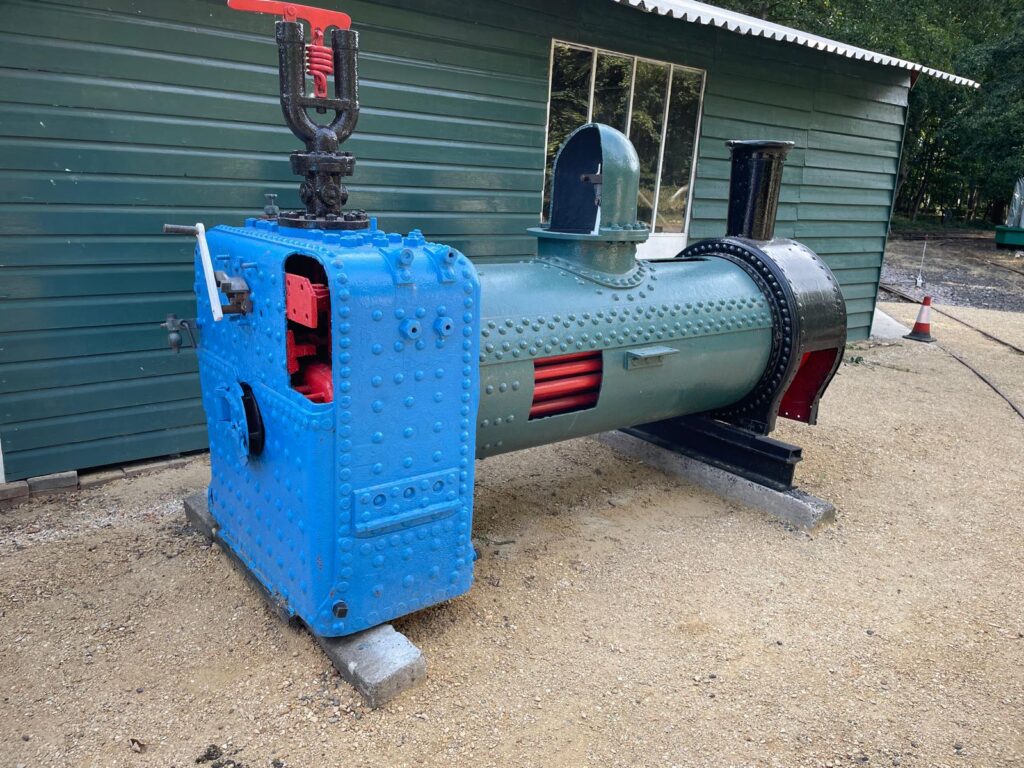
Vulcan Foundry 0-4-2T works no. WF 1160
Status: STATIC DISPLAY
Built: 1886 by RAR
Name: Mars
Type: Steam Engine (missing frames)
Original Location: Royal Arsenal, Woolwich
Only the boiler survives of this unusual locomotive, was part of a batch of 4 locomotives constructed for the Royal Arsenal, Woolwich. The batch comprised: 1159 – Jupiter, 1160 – Mars (this locomotive), 1161 – Saturn and 1162 – Vulcan; for use on the to Woolwich Arsenal’s 18″ gauge railway. It transferred to Longmoor Railway Engineering School in 1905 (after a brief spell in Chatham Dockyard) when its frames were scrapped and it’s boiler had cut-away sections added to show elemental engine construction for instruction of military railway trainees before going on display at the Museum of Army Transport at Beverley, Yorkshire until 2004 then onto Shildon before joining the Gunpowder Railway due to her historic connections to the Royal Arsenal in Woolwich.
The locomotive is unusual as it was a “well-and-back tank” design, meaning their water was stored both between the frames and in a rear bunker.
Note – steam locomotives never operated at the Royal Gunpowder Mills.
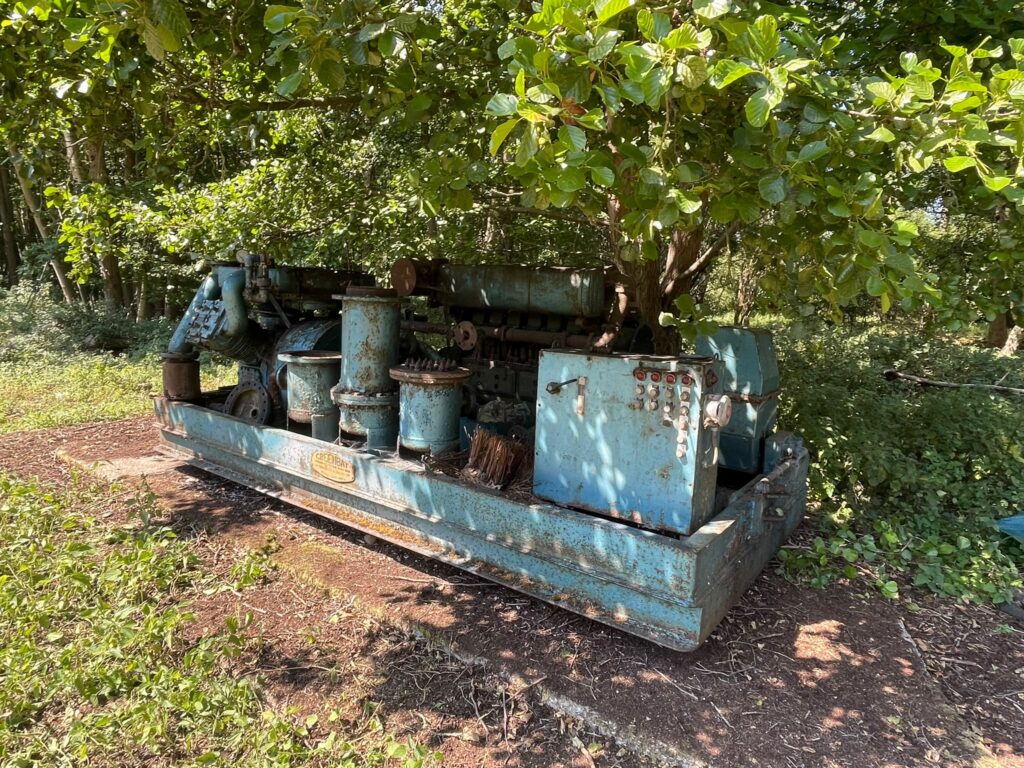
Greenwood and Batley 4wDE works no. 6099
Status: STATIC DISPLAY (OUT OF VIEW)
Built: 1964 by Greenwood and Batley
Name: BB307
Original Location: Safety in Mines Research Station (formerly RAF Harpur Hill) Buxton
This locomotive is completely unique. Greenwood and Batley only made battery electric locomotives. They made 1367 of them. However, they were commissioned to make one Diesel Electric locomotive – and this is it.
BB307 is uniquely powered by a Ruston 6YDA 84hp diesel engine which is then used to generate electricity to power the vehicle and its associated train. This locomotive did not operate on its own, it was part of a 3 vehicle train used specifically for research into the risk and impact of underground explosions within a mine!
The locomotive is currently not visible within the Railway Works – it is stored a short distance away. The longer-term aim is to cosmetically restore and preserve the locomotive and its associated vehicles (1 of the 2 is on-site) and place this on static display adjacent to the Railway Works staff car-park on a section of 3-foot railway. If you can help us with this we’d be hugely grateful.

Ruston & Hornsby 20DL 4wDM works no. 235624
Status: STORED IN PARTS
Built: 1945
Name: Budleigh
Original Location: Unknown
Locomotive was originally delivered new to Ministry of Supply and was built to a gauge of 2 feet. In January 1959 was sold to Fairy Glen Miniature Railway and re-gauged to 18 inches. It was then sold on again in 1965, placed into storage and changed hands several more times.
At sometime after 1974 the engine and transmission were removed and the locomotive received a mock ‘steam outline’ body before being used as a static exhibit as part of the Bicton Woodland Railway.
In 1999 the locomotive was sold to Royal Gunpowder Mills in kit form as part of the disposal by Bicton of former Royal Arsenal stock from Woolwich. It is currently stored as for our use would require major re-gauging, installation of a new engine and transmission, plus a reconstruction of a ‘heritage’ style body.
NOTE: This locomotive will soon be leaving the Gunpowder Railway for a new home.