
Since 1856: 170 years of narrow-gauge railway use
Gunpowder production at Waltham Abbey began in the mid‑seventeenth century, when the site relied entirely on its extensive network of waterways. For more than two hundred years, every material needed for gunpowder (acid, nitrocellulose, coal, sulphur, charcoal, saltpetre) moved by barge between widely spaced factory buildings designed to prevent a single explosion from triggering others. This water‑based system served well until the Crimean War created unprecedented demand for explosives.
In 1856, new steam‑powered mills were built on the south and east sides of Queen’s Mead, and with them came the first railways: initially simple wooden tramways carrying hand‑pushed wagons. The earliest line linked the now‑demolished charcoal mill and mixing house near today’s roundabout to the mills south of Queen’s Mead, the small stores, and the main canal to the east. By 1888 this 2 ft 3 in gauge system, mostly laid on raised wooden platforms level with the mill floors, had reached as far as the present viewing tower. Wagons were turned on small metal turntables (one of which is in use today within the Railway Works), and the rails themselves were wooden beams faced with iron on the top and inner surfaces.

People pushing wagons used in the production of gunpowder in 1915.
Meanwhile, industrial narrow‑gauge practice was changing. In 1862, John Ramsbottom of the London & North Western Railway introduced an 18‑inch gauge system at Crewe Works, demonstrating that a very narrow gauge allowed tight curves, safer movement inside buildings, and the ability to transport awkward loads on multiple small trucks. The Government quickly recognised the advantages, and 18‑inch systems spread across military sites including Woolwich Arsenal and Chatham Dockyard. At Waltham Abbey, conversion to 18‑inch gauge began in the 1890s as the site expanded into cordite production and grew northwards and eastwards. The South Site, across the Waltham Abbey–Waltham Cross road, was also developed for new propellant manufacture. Wagons continued to be pushed by hand, and in the most sensitive cordite areas all‑wooden rails were used to avoid sparks. A proposal to use brass rails was rejected on cost grounds, so the site relied on careful design and spark‑resistant phosphor‑bronze wheels.
By the turn of the century, both the North and South Sites used 18‑inch gauge stock supplied from the Royal Aresenal in Woolwich, but the two halves of the factory remained separate until the First World War. The outbreak of war in 1914 brought a dramatic increase in demand for explosives, and with it the need for a fully integrated railway. In 1916–17 a major new line was constructed to link the two sites. This was a significant engineering achievement: over one and a half miles of heavier track suitable for locomotives, three swing bridges to allow barge traffic to pass, and a tunnel beneath Highbridge Street that also had to pass under gas and water mains and then over the main sewer. Because the railway needed sufficient clearance under the road, the track was laid around three feet below normal river level, protected by a substantial retaining wall. The tunnel survived until the road bridge was rebuilt in 1967, when it was sealed off.
The new line also connected with the standard‑gauge branch serving Enfield’s Royal Small Arms Factory, which itself joined the Great Eastern Railway at Brimsdown. Exchange sidings beside the River Lee allowed transfer of munitions between the two gauges, although coal for the Mills’ own powerhouses and gas works continued to arrive by barge. With the new locomotive‑worked sections came strict operating procedures: signals protected the swing bridges, and a rope ring token system controlled access through the tunnel. The railway carried everything from guncotton and cordite to acid retorts and even baskets of laundry, though no evidence survives that it routinely carried passengers as the systems at Woolwich Royal Arsenal and Chatham did.
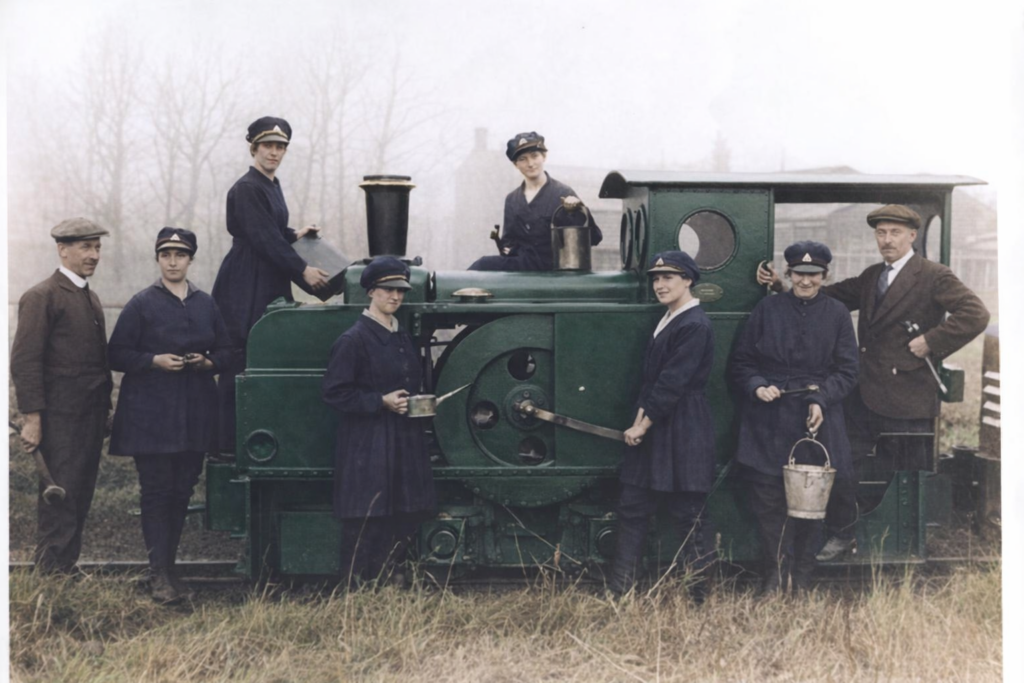
Various staff with a Ruston‑Proctor ZLH paraffin locomotive in 1918.
Because of the ever‑present risk of sparks, steam locomotives were forbidden. Instead, in 1917 the Mills purchased four Ruston‑Proctor ZLH paraffin locomotives, each weighing four and a half tons and capable of hauling nine loaded bogie wagons at up to six miles per hour. From the same year onwards, small battery‑electric locomotives from various manufacturers were introduced, and these gradually became the backbone of the system. Additional battery units arrived in the late 1930s and continued in use during the Second World War. The Ruston‑Proctor locomotives were disposed of during the 1920s; the last known survivor ended its days in the Oakley slate quarries at Blaenau Ffestiniog and was scrapped in 1953.
Unlike many wartime industrial railways, Waltham Abbey’s system did not contract after the 1918 Armistice. Instead, it remained active through the inter‑war years and into the Second World War, still serving a busy explosives‑manufacturing complex. The turning point came in 1943, when due to its close proximity to London production ceased and transferred to the newly established ROF Bishopton site in Scotland; and the Waltham Abbey site itself shifted to research, later becoming the Royal Armaments Research & Development Establishment (RARDE).

Ruston Procter ZLH locomotive pulling trays of cordite in 1917.
With manufacturing gone, the railway’s primary purpose evaporated. Locomotive‑worked sections fell silent, hand‑pushed movements dwindled, and by 1954 the system closed entirely. Over the following decade and a half, the tracks were progressively lifted, leaving only scattered traces of what had once been a railway network as extensive and intricate as the waterways that preceded it.
The Railway Today
The present day Gunpowder Railway runs a 2 foot 6 inch gauge, an unusual gauge historically favoured by the Ministry of Defence and follows the route of the perimeter patrol path used by the ERDE. The re-installation started after the site was decommissioned in 2003 and took nearly 20 years to be restored to the railway open today.

The railway under reconstruction in 2007.
The railway reopened to carrying passengers in late 2019 and after a delay by Covid-19 completed its first full running season in 2022.
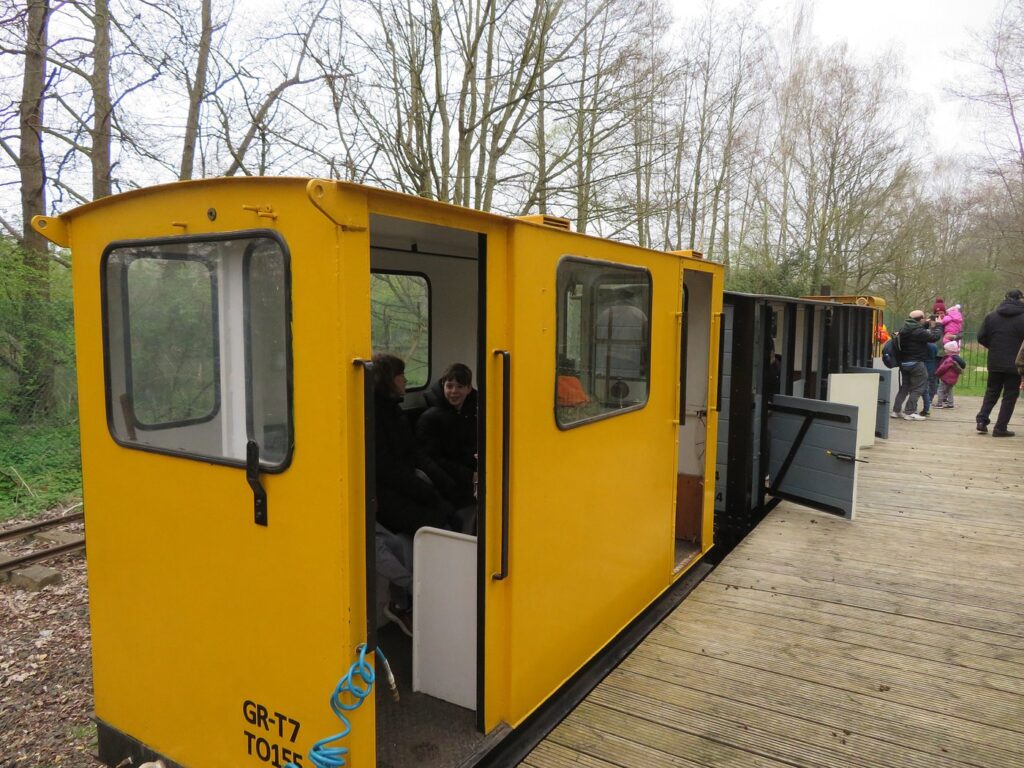
A train at Powdermill Cut station ready for its next run in 2024.
The 762mm narrow gauge line runs in a north/south direction immediately inside the western boundary of the Gunpowder Mills site. The main line of the railway is single track, approximately three quarters of a mile in length, and is laid in part on the formation of the former perimeter security patrol road. At the northern station (Powdermill Cut) and southern station (Long Walk) limits of the main line are run-round loops and passenger platforms with ramped disabled access.
The main sheds and workshops for the line are situated at the northern end, to the eastern side of the main running line, with the connecting spur and sidings adding a further eight hundred yards of track.
Due to the nature of the terrain and the location of the Gunpowder Railway immediately adjacent to the River Lea, the railway features a number of steep gradients along its main line and across its yard.
Buy the book - Railways of the Royal Gunpowder Mills by John Jenkins
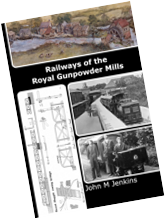
Republished in 2026 read the full history of the original railways on site since 1856 and how the railways were essential to the safe movement of materials around the site and beyond via the exchange sidings with the LNER at the Small Arms Factory in Enfield.
This book was written by Dr John M Jenkins, who worked at the Explosives Research and Development Establishment at Waltham Abbey.