
The Gunpowder Railway started in 1856
Gunpowder production began at the Royal Gunpowder Mills in the mid-17th century. Factory buildings were spaced far apart to stop an explosion in one building igniting an explosion in another. For 200 years, canal boats were used to transport materials such as coal, sulphur, charcoal and saltpetre between the factory buildings.
Then, in 1856 the first wooden tramways and wagons were introduced. The site expanded to accommodate the manufacture of new explosives and propellants (such as cordite).
The system expanded with the development of the site during the remainder of the 19th Century, with conversion to 18” gauge taking place during the 1890’s. This made the sites railways compatible with the other military establishments at Woolwich Arsenal, Chatham Dockyards and Upnor.

People pushing wagons used in the production of gunpowder in 1915.
To avoid sparking an explosion, railway wagons were fitted with spark-resistant phosphor bronze wheels. All rolling stock was pushed by hand until the outbreak of the First World War.
The war created a huge rise in the demand for explosives. In response, petrol/paraffin and battery powered locomotives were introduced to increase production.

Ruston Procter locomotive pulling trays of cordite in 1917.
Further battery electric units were purchased in the late 1930’s and during the Second World War. However, the site stopped manufacturing explosives and propellants during the Second World War due to its close proximity to London causing the railways on the site to go into decline after 1943, and were probably largely out of use by 1954.
In the 1960’s with the railway fell out of use and was gradually dismantled. The site then became a top-secret Explosives Research and Development Establishment (ERDE).
The Railway Today
The present day Gunpowder Railway runs a 2 foot 6 inch gauge, an unusual gauge historically favoured by the Ministry of Defence and follows the route of the perimeter patrol path used by the ERDE. The re-installation started after the site was decommissioned in 2003 and took nearly 20 years to be restored to the railway open today.

The railway under reconstruction in 2007.
The railway reopened to carrying passengers in late 2019 and after a delay by Covid-19 completed its first full running season in 2022.
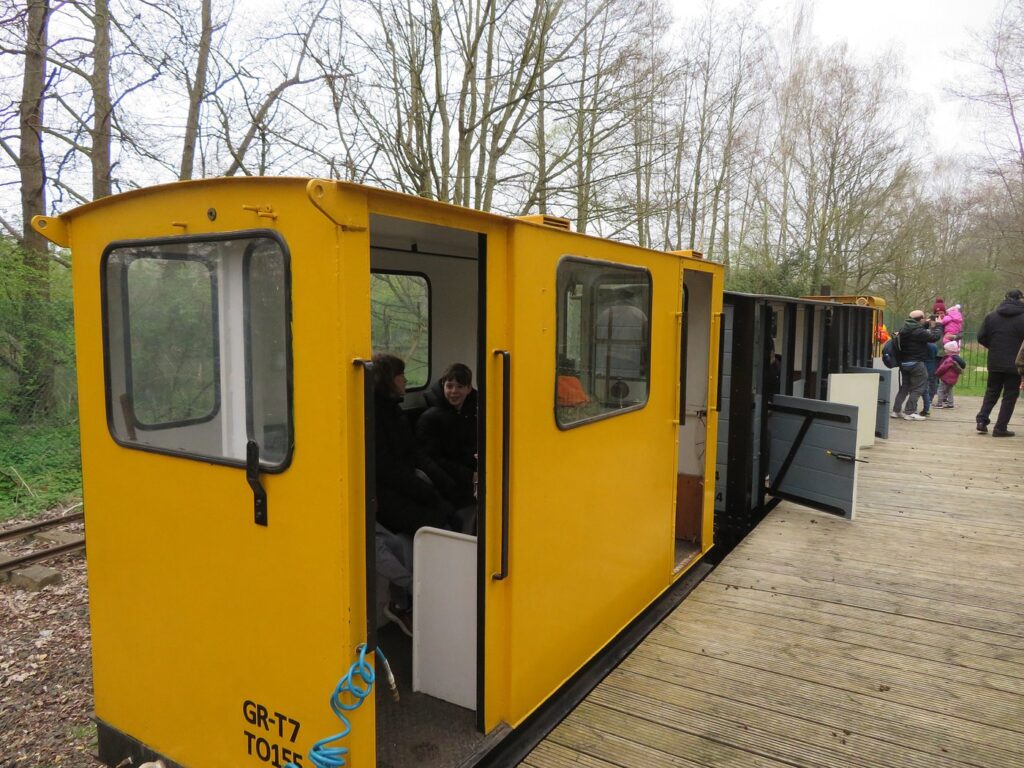
A train at Long Walk station ready for its next run in 2024.
The 762mm narrow gauge line runs in a north/south direction immediately inside the western boundary of the Gunpowder Mills site. The main line of the railway is single track, approximately three quarters of a mile in length, and is laid in part on the formation of the former perimeter security patrol road. At the northern station (Powdermill Cut) and southern station (Long Walk) limits of the main line are run-round loops and passenger platforms with ramped disabled access.
The main sheds and workshops for the line are situated at the northern end, to the eastern side of the main running line, with the connecting spur and sidings adding a further eight hundred yards of track.
Due to the nature of the terrain and the location of the Gunpowder Railway immediately adjacent to the River Lea, the railway features a number of steep gradients along its main line and across its yard.